
Traveling to Iceland can be expensive in some areas, but handling money isn’t one of them.
There are no confusing payment rules, no tipping pressure, and no need to carry stacks of cash. Most budget mistakes visitors make here come from assumptions based on other countries, not from Iceland itself.
This guide covers the everyday money basics you actually need, so you can avoid unnecessary fees, stress, and overpaying during your trip.
Cash vs cards in Iceland (and when cash is useful)
Short answer: you don’t need cash in Iceland.
Iceland is one of the most card-friendly countries in the world. Credit and debit cards are accepted almost everywhere, including restaurants, cafés, gas stations (even unmanned ones), parking systems, public toilets, and small shops, even in rural areas. It is also completely acceptable to pay with card small amounts like a single coffee.
Contactless payment is standard, and Apple Pay or Google Pay usually work without issues. For larger amounts, terminals may occasionally ask for a PIN, which is normal.
Do you need to withdraw cash “just in case”?
For most travelers, no. Many visitors never use an ATM at all.
When cash can be useful
Cash may help in very limited situations, such as small flea markets or occasional souvenir stalls, but it’s rarely required and never essential.
This card-first system is also why things like parking fees and toilet access work the way they do, something we explain in more detail in Parking fees and hidden costs in Iceland.
Bottom line: bring a card with a PIN, because many everyday payments in Iceland require it. This is especially true at unmanned gas stations, where PIN verification is standard and some cards simply won’t work without it. If you want to understand how fueling and payment actually work, and why having the right card matters, we explain it in Fuel prices in Iceland: where to fill up and how to pay less.
Currency exchange myths (and how people overpay)
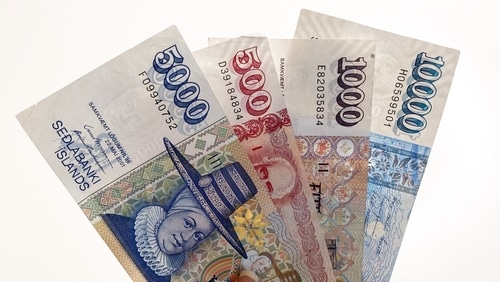
Iceland uses the Icelandic króna (ISK). Prices are always shown in ISK, and that’s what you should pay in.
Should you exchange money before arriving?
No. Exchanging cash in advance usually gives worse rates, not better ones.
The most common (and costly) mistake
When paying by card, terminals sometimes ask whether you want to pay in ISK or your home currency (EUR, USD, etc.). Always choose ISK.
Paying in your home currency triggers dynamic currency conversion, which adds a hidden markup. Your bank almost always gives a better rate when you pay in ISK.
Airport exchange counters
They exist, but they’re rarely useful except in emergencies.
Bottom line: don’t exchange cash, don’t pay in your home currency, and you’ll avoid most unnecessary fees. If your bank charges foreign-transaction or ATM fees, those come from your bank, not from Iceland.
A quick note on numbers and separators
Another small detail that can be confusing for some is how numbers (and especially price tags) are written.
In Iceland, prices use a dot as a thousands separator, not a decimal point. So when you see a price like 13.000 ISK, it means thirteen thousand Icelandic króna, not thirteen króna.
There are no cents in ISK pricing, so you won’t see decimal values in everyday prices.
For example:
- 13.000 ISK = thirteen thousand króna
- 800,00 ISK simply means 800 króna
If you’re used to commas for thousands and dots for decimals, it’s worth slowing down for a second before paying, especially when numbers get large.
Tipping culture in Iceland (and common mistakes)
Tipping is not expected in Iceland, but it’s appreciated in cases of exceptional service.
Staff in restaurants, cafés, taxis, and tours receive regular wages. Service charges are already included in prices.
Do you need to tip?
No. Not tipping is completely normal and not considered rude.
Can you tip if you want to?
This is especially useful to know when eating out, since restaurant prices are already higher than many visitors expect. If you want to plan meals without relying on tipping culture or surprise costs, Eating on a budget in Iceland goes through practical food choices in detail.
Bottom line: tipping is optional, not expected, and never required.
SIM cards vs eSIMs vs roaming in Iceland
Mobile coverage in Iceland is very good in towns and along the Ring Road. Most travelers have more options than they think.
EU/EEA travelers
If you’re visiting from the EU/EEA, your mobile plan usually includes roaming at home rates. Check your data limits, but many travelers don’t need anything extra.
Non-EU travelers
If roaming fees are high, a local SIM or eSIM is usually cheaper. eSIMs are convenient and avoid store visits, while physical SIMs are available at the airport and in larger towns.
Free Wi-Fi
Free Wi-Fi is widely available in hotels, guesthouses, cafés, restaurants, and many gas stations. You won’t be offline as much as you might expect.
Limited coverage in remote areas
While coverage is very good overall, there are still parts of Iceland where mobile signal can be weak or unavailable. This is normal and expected in remote areas.
You’re most likely to lose reception in:
- The Highlands and interior routes
- Remote Westfjords roads
- Parts of Snæfellsnes and the East Fjords, especially away from towns
- Mountain passes and sparsely populated stretches of road
This usually isn’t a problem for daily travel, but it’s worth planning ahead. Download offline maps, save reservations locally on your phone, and don’t rely on live data for navigation or payments in remote areas.
Reliable connectivity in towns and along main routes still makes it easy to use parking apps, check fuel prices, and monitor weather and road conditions while driving, which we explain in Fuel prices in Iceland and How to save money on car rental and transportation in Iceland.
How to avoid overpaying for data and connectivity
Most travelers don’t need nearly as much data as they think.
Simple ways to save:
- Download offline maps before arrival
- Use Wi-Fi for photo uploads and backups
- Turn off automatic cloud syncing on mobile data
- Avoid large airport data plans unless you truly need them
Navigation, messaging, and basic browsing use very little data. Heavy usage usually comes from social media uploads and video.
A note on public toilets and small payments
Many public toilets, especially at popular sites, use card- or app-based payment systems. Cash is rarely accepted or needed. This is part of the same system used for parking at nature sites, where license-plate payments and apps are the norm, something we explain step by step in Parking fees and hidden costs in Iceland.
Why money logistics rarely cause problems in Iceland
Iceland may challenge your budget in areas like accommodation (add link to the save blog) and transport (add link to your blog), but everyday money handling is simple.
· Cards work almost everywhere.
· Cash is rarely needed.
· Tipping isn’t expected.
· Internet access is easy and flexible.
Once you understand these basics, there’s very little left to worry about and no reason to spend more than you need to.
Final note: Payment systems, mobile coverage, and bank policies can vary depending on provider, country, and individual circumstances. The guidance here reflects common travel experiences and typical conditions, but what works smoothly for one person may differ for another. Always check your own card terms, roaming limits, and daily spending caps before traveling, and adjust based on your needs and comfort level.