
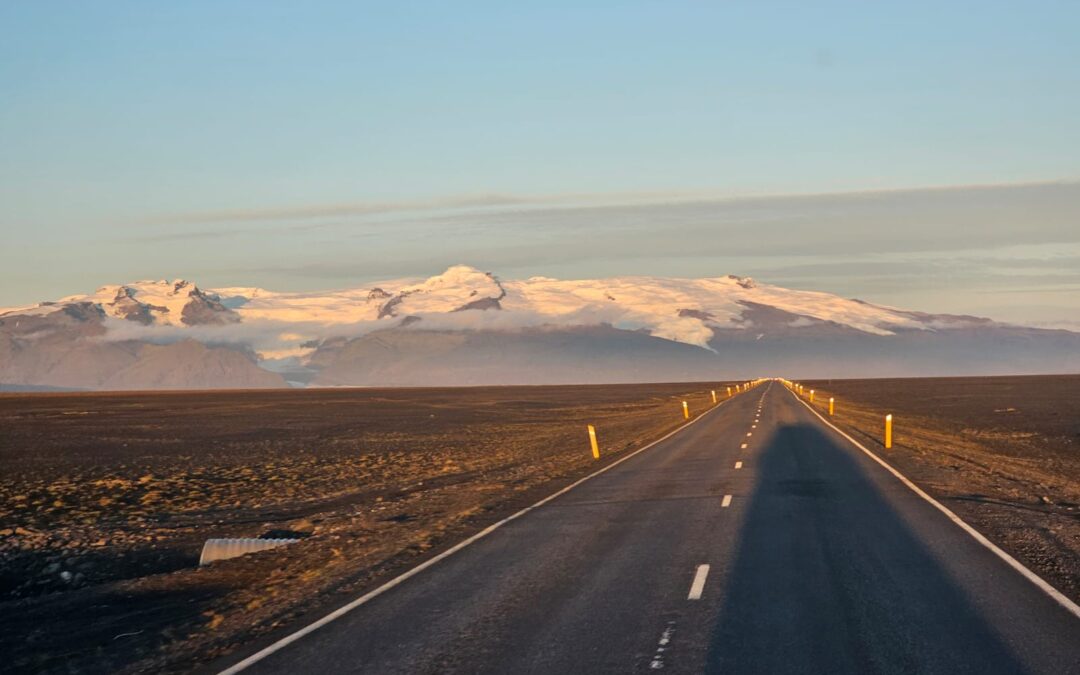
Hello, dear traveller. My name is Óskar Freyr, and I am a tour guide in Iceland.
For many years, I have been running different kinds of tours: day tours, two- and three-day tours, and full Ring Road tours, which now number close to one hundred in total. I have also driven well over 100 super jeep tours to glaciers, guiding glacier hikes and ice cave tours along the way.
I have been driving in Iceland officially since I was 17, but because I grew up in the countryside, I actually started driving at the age of 12.
Thankfully, I have been driving for decades without a single accident. There are many reasons for this, but the main one is simple: I have always been very aware of the dangers and I take my responsibility as a driver seriously. When I began driver-guiding, that awareness grew even stronger, along with a deep respect for the risks that exist on Icelandic roads.
In 2025 alone, I avoided 16 near-death situations. Some examples include:
- Cars stopping on the road to take pictures
- Cars entering the road without checking distance
- Cars using passing lanes at T-junctions as parking spots
- Drivers frozen with fear on icy roads, driving in the middle of the road
- A driver overtaking my bus on the Ring Road while I was making a 30-degree right turn, with an oncoming car only 200 meters away
By braking hard and moving halfway off the road, I managed to avoid what would almost certainly have been a multiple-fatality accident.
This is why I want to share a few important pointers with you, from the perspective of someone who drives Icelandic roads every day.
Basic but critical rules
1. Always wear seatbelts when driving in Iceland. By law, everyone in the car must wear one at all times. At best, failing to do so results in a heavy fine.
2. Do not take pictures or videos while driving, and do not use your phone.
3. Headlights must always be on, day and night. High beams must be turned off when meeting oncoming traffic, and fog lights must never be used in towns. Using hazard lights in snowstorms or fog is not standard practice in Iceland.
Stopping and passing safely
4. Never stop on the road or partly on the road, even if you think hazard lights will keep you safe. This is extremely dangerous, and unfortunately very common. Enjoy the view with your eyes, and use the next safe pull-off to take photos.
5. Do not speed up when a vehicle approaches you from behind. Drive at a pace you are comfortable with, maintain a steady speed, and signal to the right when it is safe to pass. Drivers may briefly flash their hazard lights after overtaking as a thank-you.
6. As a bus driver with a speed limiter around 99 km/h, I truly appreciate when visitors drive at a steady, predictable pace. When a car driving 60–80 km/h suddenly speeds up while I am overtaking, it puts my passengers and me in serious danger.
Bridges, junctions, and roundabouts
7. One-lane bridges require extra attention. A common Icelandic habit is that three cars pass, and the fourth stops to let traffic through from the other side. Visibility is often poor, so approach slowly and assess the situation carefully. These bridges are gradually being removed, but while they remain, caution is essential.
8. When entering a main road, always come to a full stop and look twice. Larger vehicles need much more distance to slow down, and this will help you better judge their speed.
9. Roundabouts: Icelandic traffic law changed in 2020. Vehicles already inside the roundabout have the right of way, and the inner lane has priority.
If you are taking the first exit, you must stay in the outer lane. Always yield to traffic already in the roundabout, many accidents happen because drivers fail to do this.
10. Passing lanes on the right side of the road at T-junctions or three-way intersections must always be kept clear. Never stop there, not even briefly. These lanes allow traffic to flow around vehicles waiting to turn left, and cars, buses, and trucks may pass through at speeds of up to 70 km/h.
11. On roads with two lanes, the right lane is for slower traffic and the left lane for faster traffic. Do not try to regulate or control the speed of others, this creates unnecessary danger.
Weather, fatigue, and wildlife
12. In icy conditions or strong winds, driving in the middle of the road is not the solution. If you do not feel confident driving, find a safe place to stop and wait. If you are driving very slowly, please allow more experienced drivers to pass when it is safe.
13. When planning your day, avoid unrealistic distances that force you to drive for many hours while exhausted. Even in good weather, driving in Iceland can be demanding.
14. During summer, sheep are always a possibility on the roads. If you see a ewe on one side and lambs on the other, expect the lambs to run across suddenly. Slow down, there are many warning signs for this.
If you hit a sheep or a lamb, go to the nearest farm and inform the farmer, then report the incident to the police. You will need a police report for insurance purposes, as vehicle damage is likely.
In eastern Iceland during winter, you may encounter reindeer, sometimes directly on the road. Stay alert.
Respecting nature
15. Off-road driving is illegal in Iceland and taken very seriously. If Icelandic drivers see this happening, we will document it and report it to the police. The fines are severe.
16. Moss is protected by law in many areas. Damage caused by walking on it can take up to 100 years to heal. Please respect this, there are countless marked paths available for walking.
There are probably a few things I have forgotten, but I hope this helps you travel safely and truly enjoy the incredible nature Iceland has to offer.
If you have any questions, feel free to contact me at hello@oskartheguide.is
Safe travels,
Óskar